
Every large or high-security facility eventually needs one thing: a single room where all of its security, safety and building intelligence comes together. That room is the Security Operations Center (SOC) — the centralized nerve center where video surveillance, access control, fire and life-safety systems, perimeter security and communication networks are monitored, correlated and acted upon in real time.

Depending on how a facility is structured and what it prioritizes, this same core concept goes by several names. In enterprise and corporate settings it is most often called a Command Center. In large, multi-system smart infrastructure — townships, airports, transportation networks and city-scale deployments — it is typically built out as an Integrated Command and Control Center (ICCC). Where the primary mandate is life safety, the facility is generally designated a Fire Command Center (FCC), built around fire detection, suppression and emergency evacuation coordination.
Whatever the name on the door, the underlying purpose is the same: give operators a single point of visibility and control over everything happening across a site, so that incidents are detected sooner, understood faster and resolved with a coordinated response instead of scattered, siloed reactions.
What a SOC / Command Center does
A SOC functions as the operational brain of a facility's security and safety infrastructure. Rather than having CCTV, access control, fire alarms and perimeter sensors each report to a different screen, room or team, a SOC brings every one of these data streams into a unified environment — a video wall, multi-monitor operator workstations and an integrated software platform — so that a small, trained team can maintain constant situational awareness across an entire facility or portfolio of sites.

This centralization is what allows a SOC to do more than simply watch cameras. It enables cross-system correlation: an access-control alarm, a motion-detection event and a specific camera feed can all be automatically linked and presented together, giving operators immediate context instead of forcing them to piece together what happened from separate systems.
Core functions
- Video surveillance monitoring — live and recorded CCTV/VMS feeds with analytics alerts for motion, intrusion and object detection
- Access control oversight — real-time door, gate and turnstile events, forced-entry and tailgating alarms, credential management
- Perimeter & intrusion detection — fencing, bollards, boom barriers, laser/IR beams and road blockers flagged and acted upon
- Fire & life-safety monitoring — fire panels, smoke/heat detection, suppression status and evacuation coordination
- Incident management — structured workflows to log, escalate and resolve incidents with direct links to response teams
- Building & environmental integration — HVAC, power and lighting brought into one operational view in advanced ICCC deployments
- Audit trails & reporting — continuous logging of events, access history and system status for compliance and investigations
How a SOC is typically structured
A SOC is generally built around three layers working together:
- The physical layer — a dedicated, access-controlled room with a video wall, redundant power and hardened network connectivity
- The technology layer — the integration platform (PSIM or VMS) that pulls together feeds and data from every connected subsystem
- The human layer — the trained operator team that monitors, verifies and escalates events according to defined protocols and SOPs

Why the naming varies
- Command Center — general-purpose term for corporate, commercial and enterprise environments
- Integrated Command & Control Center (ICCC) — city-scale or large-infrastructure projects unifying security, traffic and utilities
- Fire Command Center (FCC) — life-safety coordination, often code-mandated in high-rises

In practice, many facilities operate a hybrid: a single physical SOC that performs the functions of a Command Center, an ICCC and an FCC simultaneously, structured with dedicated workstations, protocols or sub-teams for each function.
Ideal applications: corporate headquarters, airports and transportation hubs, smart cities, data centers, manufacturing and industrial facilities, high-rise and mixed-use buildings, government and defence installations — any large facility requiring coordinated security and safety oversight.
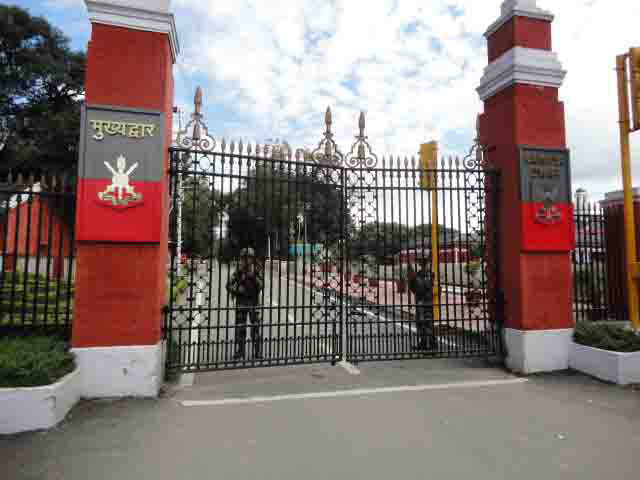
Indian Defence & Military Strategic Command
Mission-critical military infrastructure requires a level of resilience and integration far beyond standard commercial SOCs. Strategic command environments for the Indian Defence forces are designed as hardened, high-availability hubs capable of managing high-value asset protection, border-surveillance telemetry and rapid-response coordination in contested environments. These facilities integrate advanced encryption, redundant satellite links and real-time tactical data feeds to ensure absolute situational awareness.


Why a centralized SOC matters
Without a centralized SOC, a facility's security and safety systems operate as disconnected silos — each generating alerts that require someone to notice, interpret and act on in isolation. A properly designed SOC replaces this fragmented approach with unified visibility, faster detection-to-response times and coordinated action across every system on-site. Whether branded as a Command Center, an ICCC or a Fire Command Center, it is this centralization — not any single piece of technology — that turns a collection of independent security systems into one coherent operational capability.
Plan your Security Operations Center
From room design and video walls to PSIM/VMS integration — we deliver the complete SOC.