
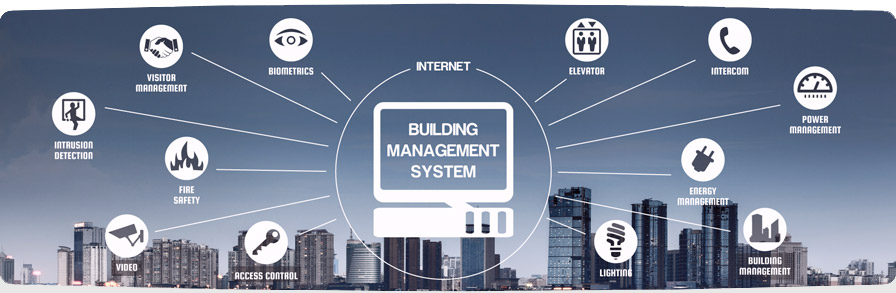
A Building Management System (BMS) is the central brain of a modern facility. Fully integrated building management solutions are used widely today to increase safety and comfort while reducing labour cost and the mistakes that come from manual operation. Aeropack Infra designs, supplies, installs and commissions BMS platforms that bring a building's mechanical, electrical and safety systems under one coordinated, automated controller — so that the building looks after itself, and your team manages by exception rather than by constant intervention.
Instead of separate panels for air conditioning, lighting, power and security, a BMS gives operators a single, graphical view of the entire building. Temperatures, energy consumption, equipment status, alarms and access events are all visible from one screen, and the system can act automatically: dimming lights in empty rooms, adjusting cooling to occupancy, shedding non-essential loads at peak tariff, and raising an alarm the moment a critical parameter drifts out of range.
What a BMS controls and monitors
- HVAC and air handling
- System integration across subsystems
- Lighting control
- Access control
- Video control
- Electrical distribution
- Energy monitoring
- Monitor and control points
- Critical power
- IT infrastructure
- Renewable energies
- Perimeter and physical security
- Central control room
The business case for a BMS is usually energy. Buildings waste enormous amounts of power heating, cooling and lighting spaces that nobody is using. A well-tuned BMS typically pays for itself through reduced energy bills, longer equipment life and lower staffing needs.
Comfort, safety and efficiency together
Occupant comfort and operational efficiency are usually treated as competing goals, but a good BMS reconciles them. By continuously sensing conditions and responding in real time, it keeps temperatures and air quality within comfortable bounds while using the minimum energy required to do so. At the same time, it strengthens safety: integration with fire and access systems means that an emergency can trigger a coordinated, automatic response across the whole building.
Open, integrated and future-ready
We build on open, standards-based platforms so that your BMS can talk to equipment from many manufacturers and can be extended as the building evolves. Integration is central to our approach — a BMS delivers its full value only when the subsystems genuinely cooperate, sharing data and acting in concert. Because we also deliver the underlying electrical, HVAC, security and cabling infrastructure, we are well placed to integrate them cleanly.
From design to ongoing optimisation
Our involvement does not end at commissioning. A BMS is most valuable when it is tuned to how the building is actually used, and usage patterns change over time. We offer monitoring, fine-tuning and maintenance so that the system keeps delivering savings and comfort year after year, and we train your operators so they can get the most from the platform day to day.
If you are constructing a new facility or modernising an existing one, an integrated building management solution can transform how it runs — quieter, safer, more comfortable and noticeably cheaper to operate. Talk to our engineers about the right level of automation for your building.
Comfort and efficiency, automatically
A building management system continuously watches and adjusts the services that keep a building comfortable and efficient — heating, ventilation, air-conditioning, lighting and more. Instead of relying on manual intervention or fixed timers, the BMS responds to real conditions: it tempers the air-conditioning as occupancy and outside temperature change, dims lighting when daylight is plentiful, and shuts services down in unoccupied zones. The payoff is a building that is both more pleasant to occupy and noticeably cheaper to run.
Insight through data
Because a BMS is constantly measuring, it also becomes a rich source of operational insight. Energy consumption can be tracked and benchmarked, faults and inefficiencies surface early through alarms and trends, and maintenance can shift from reactive call-outs to planned, condition-based intervention. Over time this data helps you target the changes that deliver the greatest savings and keep equipment running longer.
Scalable and integrated
We design building-management solutions that suit the scale of your facility, from a single building to a multi-site estate, and that integrate cleanly with the other low-voltage systems we deliver. The system grows with you, and a single coordinated interface gives your facilities team clear visibility and control without juggling disconnected consoles.
Building Automation & Management — full scope
A Building Management System (BMS), also known as a Building Automation System (BAS), is a computer-based control system that monitors and controls a building's mechanical and electrical equipment — ventilation, lighting, power, fire and security systems. Areas we cover include HVAC and air-handling integration, lighting control, access control, video control, electrical distribution, energy monitoring, critical-power management, IT systems, renewable energy, perimeter and physical security, and a central control room.
BMS systems can be linked to access control, CCTV and motion detectors, and to fire alarms and elevators. In a fire, the fire-alarm panel can shut ventilation dampers to stop smoke spreading and send all elevators to the ground floor to prevent their use.
Fire Security Services
Aero Pack's fire-security systems are expert at detecting fires and protecting people and assets:
- Smoke & fire sensors — signal the fire-alarm control panel for an immediate response.
- Fire sprinkler systems — water-based active protection that activates automatically on heat, suppressing fires before they spread.
- Fire suppression systems — gas-based agents protect critical areas without water damage to sensitive equipment.
- Fire evacuation & safety signage — complete signage for compliance and clear guidance during emergencies.
HVAC & Air Handling
Heating, Ventilation and Air Conditioning (HVAC) provides thermal comfort and acceptable indoor air quality across all building types. An Air Handling Unit (AHU) — a large metal box containing a blower, heating or cooling elements, filter racks, sound attenuators and dampers — regulates and circulates air as part of the system. We integrate HVAC and AHUs fully into our home and building-automation solutions.
Interested in BMS Solutions?
Talk to our engineers for a free, no-obligation consultation.